

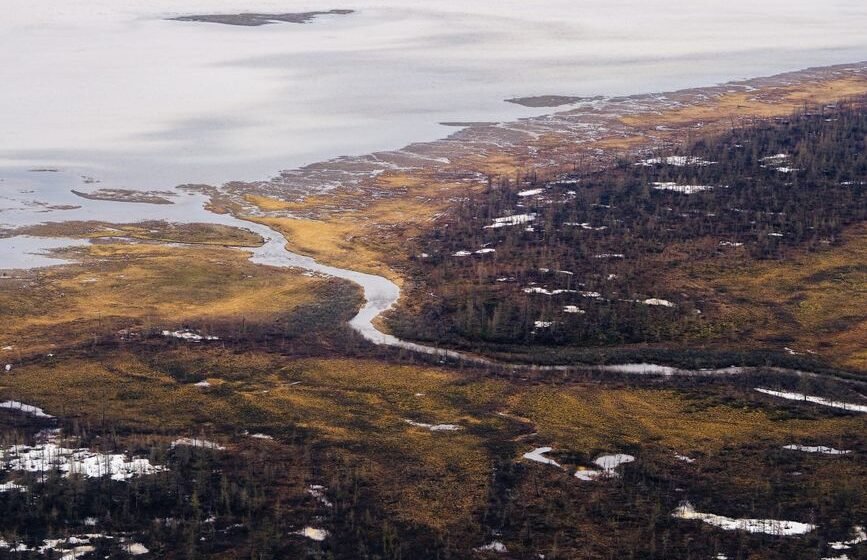
Thawing Permafrost Not Only Emits CO2, It Absorbs it Too, Shows Landmark Study
New research has revealed a surprising twist in the story of permafrost and climate change: as permafrost thaws, it not only releases carbon dioxide (CO2) into the atmosphere but also draws some of it back in. This dual role, highlighted in a recent study, adds a new layer of complexity to our understanding of the Arctic’s impact on global carbon cycles.
Table Of Content
Permafrost: A Carbon Time Bomb?
Permafrost, the layer of permanently frozen soil found in polar regions, contains vast amounts of organic material. As the climate warms, this frozen ground begins to thaw, allowing microbes to break down previously trapped plant and animal matter. This process releases greenhouse gases like CO2 and methane, which can accelerate global warming.
For years, scientists have warned that thawing permafrost could unleash a “carbon time bomb,” rapidly increasing atmospheric greenhouse gas concentrations. However, the new study suggests the situation may be more nuanced than previously thought.
Unexpected Carbon Uptake
The research team, using advanced monitoring equipment and field observations, discovered that thawed permafrost can also act as a carbon sink. As soils warm and become more active, new plant growth is stimulated. These plants absorb CO2 from the air through photosynthesis, partially offsetting the emissions from decomposing organic matter.
Lead researcher Dr. Emily Carter explained, “We found that the regrowth of vegetation on thawed permafrost can capture a significant portion of the carbon released. This doesn’t eliminate the climate risk, but it does mean the net emissions may be lower than feared.”
Balancing Emissions and Absorption
The study, conducted over several years at multiple Arctic sites, measured both the release and uptake of CO2. The findings showed that while thawing permafrost remains a net source of greenhouse gases, the absorption by new vegetation is substantial enough to warrant attention in climate models.
- Thawing permafrost releases CO2 and methane as organic matter decomposes.
- New plant growth on thawed ground absorbs CO2 through photosynthesis.
- The net effect is still an increase in atmospheric greenhouse gases, but not as much as previously estimated.
Implications for Climate Predictions
These insights could have important implications for predicting future climate change. Current climate models often assume that permafrost thaw leads to a one-way release of carbon. By accounting for the offsetting effect of plant regrowth, scientists may be able to produce more accurate forecasts.
“It’s crucial to include both sides of the carbon equation,” said Dr. Carter. “Ignoring the capacity for carbon uptake could lead to overestimating the impact of permafrost thaw on global warming.”
Ongoing Uncertainties
Despite these findings, researchers caution that many uncertainties remain. The balance between emissions and absorption depends on factors such as soil moisture, temperature, and the types of plants that colonize thawed areas. In some cases, methane emissions—which are more potent than CO2—could outweigh the benefits of increased plant growth.
Additionally, as the Arctic continues to warm, the rate and extent of permafrost thaw could accelerate, potentially overwhelming the region’s capacity for carbon uptake.
Looking Ahead
The study’s authors emphasize the need for continued monitoring and research to better understand the evolving role of permafrost in the global carbon cycle. As scientists refine their models, policymakers will have more reliable information to guide climate action.
For more details, visit the full article at this link.